Automated Threat Modeling Platform
The Unified Threat Workbench: Design, Analyze & Remediate in Minutes
The most advanced automated threat modeling platform for enterprise security teams. Upload architecture diagrams, analyze threats with AI using STRIDE, PASTA, LINDDUN, and MAESTRO, get code-level remediation, and map findings to 340+ compliance frameworks. From code commit to production.
Threat Assessment
Live Pipeline Analysis
Ayurak automatically patched 12 vulnerabilities in commit #8f2a9
Predictive Threat Modeling
Move beyond static diagrams. Aristiun's Aribot engine continuously scans your architecture, identifies attack vectors, and generates dynamic threat models that evolve with your code. From high-level design vision to operational reality.
CI/CD Integration
Native plugins for GitHub, GitLab, and Azure DevOps to block risky commits.
Multi-Framework Support
Comprehensive coverage including STRIDE, PASTA, LINDDUN, and MAESTRO.
Automated DFD Generation
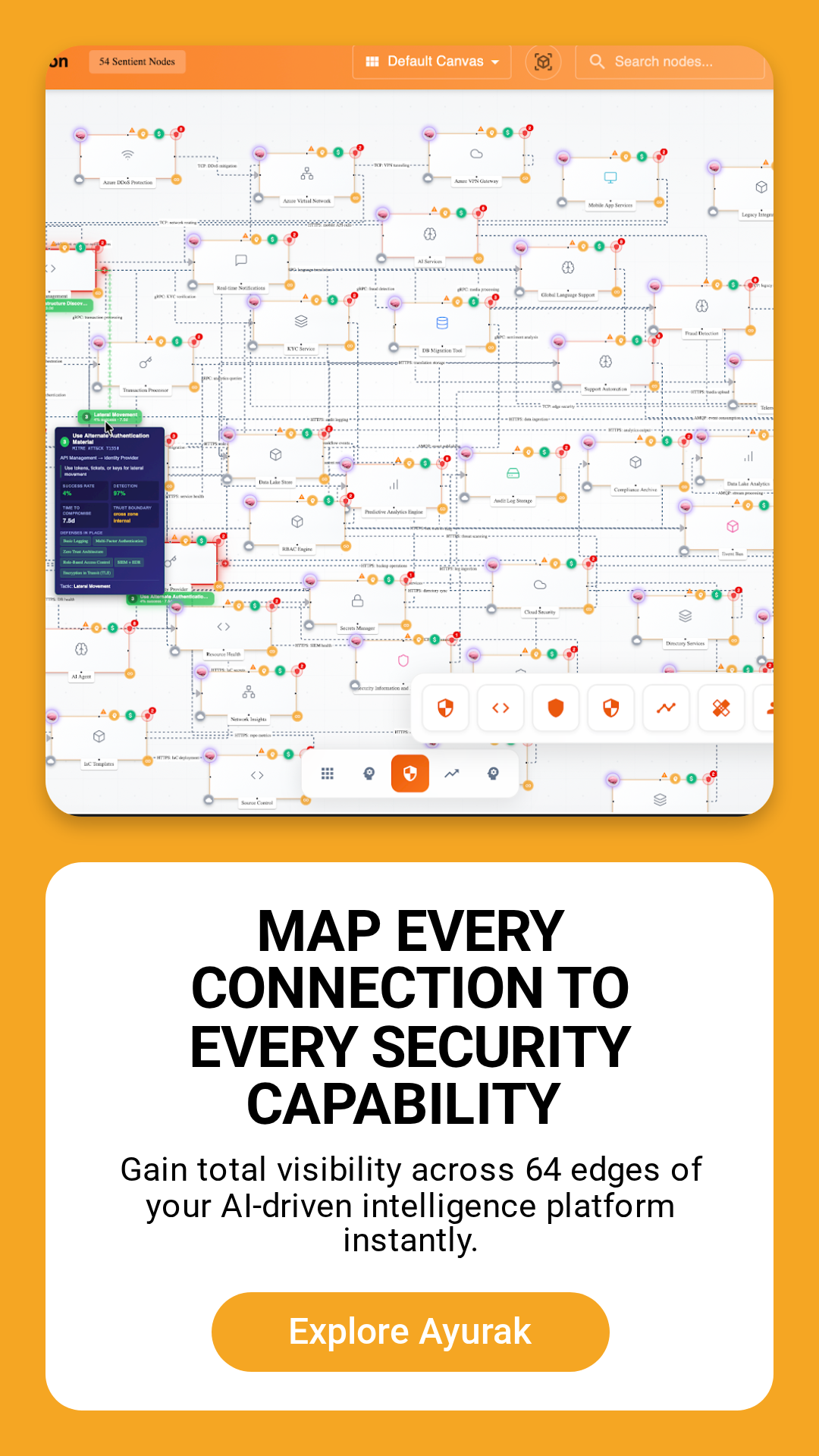
Visualize data flow diagrams automatically generated from your codebase.
Compliance Mapping
Map threats directly to NIST 800-53, SOC 2, and ISO 27001 controls.
The Unified Threat Workbench
Click on any service node to inspect its threats, view attack paths, check compliance mappings, and read AI-generated remediation plans. Hit Scan to watch the engine analyze the architecture in real time.
How the Security Workbench Works
Bring your own diagrams, collaborate in real time, generate secure architectures with AI copilots, and manage living threat models with continuous compliance and cost insights.
Upload Your Diagrams
Import existing architecture diagrams in any format: Visio, Draw.io, Lucidchart, PNG, SVG, PDF, Terraform, CloudFormation, Kubernetes manifests, or OpenAPI specs. The workbench automatically parses and maps your architecture into an interactive threat model.
Collaborate & Draw
Work together with your team to draw and refine architecture diagrams directly in the workbench. Real-time collaboration lets architects, developers, and security engineers build diagrams together with role-based access and version history.
Generate with AI Copilots
Use the Architecture Generator and AI copilots to auto-generate secure, cost-effective architecture diagrams from natural language descriptions, code repos, or cloud infrastructure scans. The AI recommends security-hardened design patterns and flags risky configurations.
Manage Living Diagrams
Diagrams stay alive, synced to your real infrastructure. As your cloud environment, repositories, and APIs evolve, the workbench automatically updates your architectural models and re-evaluates threats in real time.
Ops Metrics & Cost Analysis
Track operational security metrics, infrastructure costs, and tool spend directly from your architecture view. Identify over-provisioned resources, redundant security tooling, and cost optimization opportunities alongside your threat posture.
Continuous Compliance, Threats & Cost
Every change triggers automated threat analysis using STRIDE, PASTA, LINDDUN, and MAESTRO frameworks. Compliance mappings to 340+ frameworks update continuously, with cost-impact analysis for every remediation recommendation.
Methodology Support
Choose the threat modeling framework that fits your organization, or combine them for complete coverage.
STRIDE
Microsoft's model covering Spoofing, Tampering, Repudiation, Information Disclosure, Denial of Service, and Elevation of Privilege.
PASTA
Process for Attack Simulation and Threat Analysis, a 7-stage risk-centric methodology that aligns business objectives with technical requirements.
LINDDUN
Privacy-focused framework covering Linkability, Identifiability, Non-repudiation, Detectability, Disclosure, Unawareness, and Non-compliance.
MAESTRO
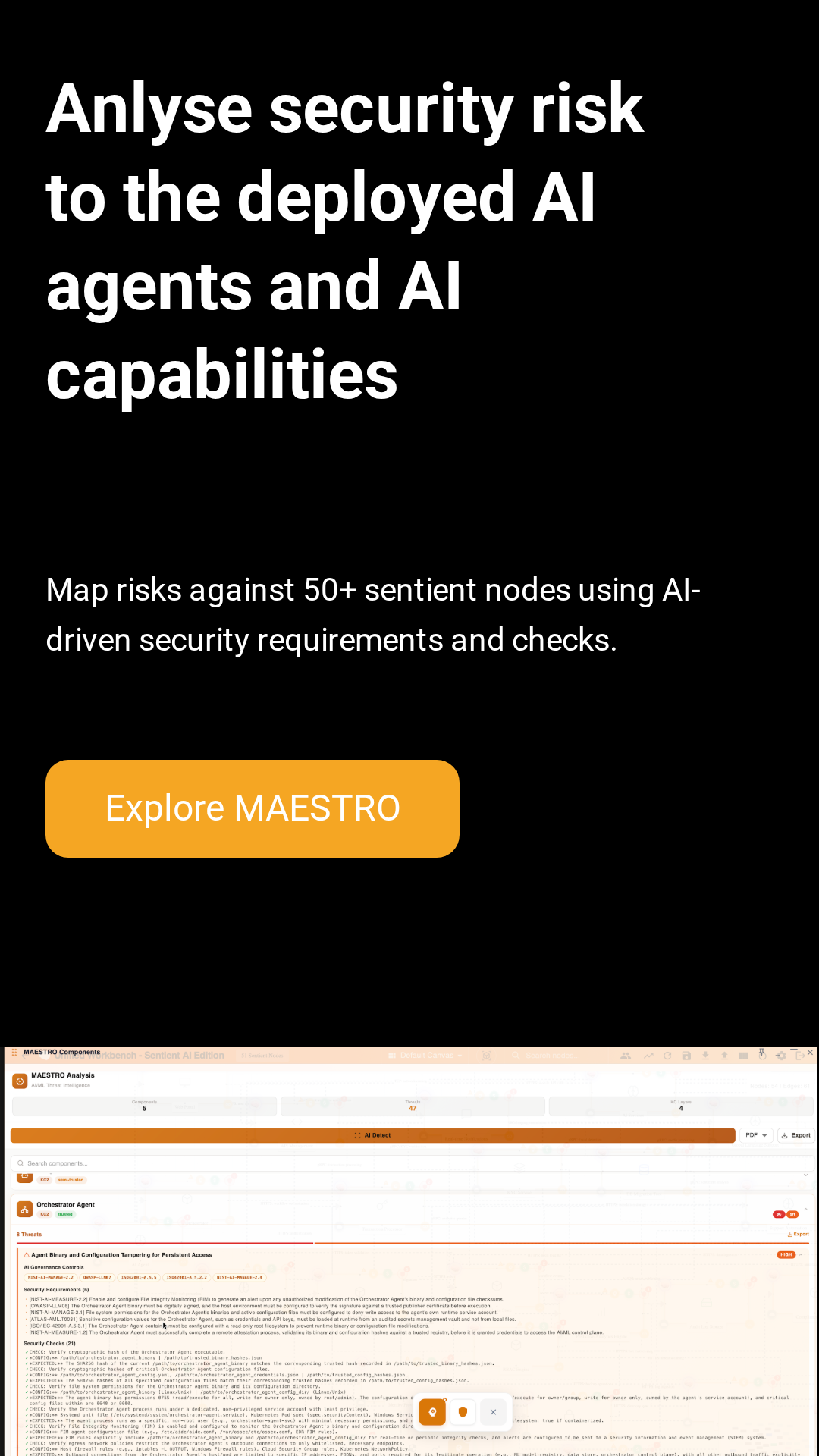
PatentedPatented AI-system threat model addressing Manipulation, AI-specific exploits, Evasion, Supply chain, Toxicity, Reconnaissance, and Operations. Purpose-built for LLM and ML pipeline security.
Attack Trees
Hierarchical decomposition of attack goals into sub-goals and leaf nodes representing individual attack steps with probability and cost.
Built for Engineering Teams
Every feature designed to integrate into your existing development workflow without disruption.
CI/CD Integration
Scan every pull request automatically. Block merges that introduce critical architectural flaws. Native support for GitHub Actions, GitLab CI, Azure Pipelines, and Jenkins.
Full-Stack Coverage
Model threats across application code, cloud infrastructure (IaC), container orchestration, API schemas, and data flows, all in a single unified graph.
Compliance Mapping
Automatically map identified threats to controls in NIST 800-53, ISO 27001, SOC 2, PCI DSS, HIPAA, and 340+ other frameworks.
Code-Level Remediation
AI generates specific, actionable fix suggestions with code snippets, library recommendations, and estimated implementation effort.
Data Flow Diagrams
Auto-generate DFDs from your codebase. Track how data moves between services, identify trust boundaries, and surface data exposure risks.
Drift Detection
Continuously compare deployed architecture against the last approved threat model. Get alerts when architectural changes introduce new risk.
The Unified Security Workbench
One always-current workspace where architecture, threats, code vulnerabilities, shadow AI, and compliance come together. Stop switching between 15 disconnected tools. Aristiun gives you one screen for your entire security posture.
Digital Twin of Your Infrastructure
Aristiun ingests your full architecture: cloud infrastructure (AWS, Azure, GCP), Kubernetes clusters, CI/CD pipelines, APIs, databases, and third-party integrations. The result is an always-current digital twin. Every change in your real environment is reflected automatically, so threats are validated against what actually exists, not what was documented months ago.
Code-Level Threat Validation
How does a threat become actionable? By tracing it to actual code paths, API endpoints, and infrastructure configs. A SQL injection threat in your API gateway gets linked to the exact controller, ORM query, database connection string, and a remediation snippet. Near-zero false positives, because every finding is validated against your real design context.
Shadow AI Discovery
The workbench scans your enterprise around the clock for ungoverned AI. That includes unauthorized LLMs, unvetted MCP servers, shadow Copilot instances, and rogue AI agents. Each discovery is auto-classified by risk, mapped to data flows, and flagged for governance. Most teams have three to five times more AI tools running than they realize.
Architecture-Aware SAST/DAST/SCA
Traditional code scanners flood you with false positives because they lack context. The workbench feeds your architecture's trust boundaries, data flows, and component topology into every scan. A vulnerable dependency in a sandboxed internal service gets deprioritized. The same CVE in a public-facing API is escalated immediately.
Live Compliance Mapping
When threats and vulnerabilities surface, the workbench maps them to controls across 340+ compliance frameworks: SOC 2, ISO 27001, HIPAA, NIST 800-53, PCI DSS, EU AI Act, and more. Your compliance posture updates in real time. Evidence is collected automatically. Audit-ready reports are one click away.
Continuous Threat Intelligence
This isn't a one-time scan. The workbench runs continuously. When a new CVE drops, a new MITRE ATT&CK technique appears, or your infrastructure changes, the digital twin re-evaluates every threat model. Over 2,900 cloud resources, repos, and APIs monitored. 487 fix-it playbooks covering everything from SQL injection to IAM misconfigs.
How the Workbench Connects Everything
Architecture
Upload or auto-discover
Digital Twin
Always-current infrastructure model
Threat Discovery
STRIDE · PASTA · LINDDUN
Code Validation
Map threats to code paths
Compliance Map
340+ frameworks auto-mapped
Shadow AI discovery runs continuously across all stages · Powered by Ayurak AI
Beyond Automated Threat Modeling
Threat modeling is just the start. Aristiun extends AI-powered security across your entire stack: code, cloud, AI workloads, and cost optimization.
Code Security & Supply Chain
Architecture-Aware · SAST · DAST · SCA · Zero False Positives
Unlike generic scanners that flood teams with noise, Aristiun's code security is architecture and application-aware. Every finding is validated against your actual design context, data flows, and trust boundaries to deliver zero false positives. SAST, DAST, and SCA scanning runs per architecture component, correlating vulnerabilities to the specific threat model of each service. Supply chain verification ensures every library, container image, and build artifact is integrity-checked within the context of your deployment topology.
AI Security & Governance
Agents · LLMs · MCP · ML Pipelines
Secure every layer of your AI stack. Runtime protection and behavioral monitoring for AI agents. Prompt injection defense and data leakage prevention for LLMs. MCP server audit and tool permission policies. Training data security and deployment governance for ML pipelines. Full EU AI Act, NIST AI RMF, and ISO 42001 compliance automation.
Shadow AI Discovery
Auto-Discover · Classify · Monitor
Auto-discover every AI asset across your organization: models, agents, MCP servers, pipelines, and data flows, including shadow AI and unvetted deployments. Continuous monitoring identifies new AI systems the moment they appear. Classify by risk level, map data dependencies, and enforce governance policies before ungoverned AI becomes a compliance liability.
Cloud Cost Optimization
Security FinOps · ROI · Consolidation
Translate security investments into measurable business outcomes. Aristiun's Security FinOps engine identifies cost savings through tool consolidation (5→1), automated evidence collection (85% reduction), and audit cost optimization (70% savings). Financial risk quantification gives CISOs the data they need for board-level reporting.
Automated Threat Modeling That Fits Your Stack
Native integrations with the tools your team already uses. Connect in minutes, and automated threat modeling runs on every commit.
Plus Slack, Teams, PagerDuty, Splunk, ServiceNow, and 50+ more via API & webhooks. See all integrations →
How Aristiun Compares to Other Threat Modeling Tools
The only platform combining automated STRIDE, PASTA, LINDDUN, and MAESTRO analysis with 340+ compliance framework mapping and AI-generated code-level remediation.
| Feature | Aristiun | IriusRisk | Microsoft TMT | OWASP Threat Dragon |
|---|---|---|---|---|
| Automated AI-Powered Analysis | Partial | — | — | |
| STRIDE Methodology | ||||
| PASTA Risk Analysis | — | — | ||
| LINDDUN Privacy Threats | Partial | — | ||
| MAESTRO (AI/ML Threats) | — | — | — | |
| MITRE ATT&CK Mapping | Partial | — | — | |
| Architecture Diagram Import | ||||
| Code Repo Auto-Discovery | Partial | — | — | |
| Code-Level Remediation | — | — | — | |
| Attack Path Visualization | Partial | — | — | |
| CI/CD Pipeline Integration | Partial | — | ||
| Compliance Framework Mapping | 340+ | Partial | — | — |
| Real-Time Continuous Scanning | Partial | — | — | |
| Free Tier Available |
Comparison based on publicly available feature documentation as of 2026. See detailed vendor comparison →
Automated vs Manual Threat Modeling
Why leading security teams are switching to automated threat modeling.
Automated Threat Modeling
- Results in minutes, not weeks
- Continuous: scans every commit automatically
- AI detects 40% more attack vectors than manual
- Code-level remediation with copy-paste fixes
- Maps to 340+ compliance frameworks instantly
- Scales from 10 to 10,000 apps with same team
- Living threat model that evolves with your code
- 97%+ consistency across all analyses
Manual Threat Modeling
- Takes days to weeks per application
- Point-in-time: outdated the moment it's done
- Depends on individual expertise and availability
- Written recommendations, not executable fixes
- Manual compliance cross-referencing
- Doesn't scale: needs more architects per app
- Static document that gathers dust
- Quality varies by practitioner
Frequently Asked Questions About Automated Threat Modeling
Everything you need to know about AI-powered threat modeling and how it transforms your security posture.
What is automated threat modeling?
How does AI-powered threat modeling differ from manual threat modeling?
What threat modeling methodologies does Aristiun support?
How does automated threat modeling integrate with CI/CD pipelines?
How many compliance frameworks does automated threat modeling map to?
What is the difference between threat modeling and vulnerability scanning?
What is Ayurak AI and how does it power automated threat modeling?
How much does automated threat modeling cost?
Can automated threat modeling replace security architects?
What types of architectures can be automatically threat-modeled?
How does automated threat modeling support NIST based assessments?
See Automated Threat Modeling in Action
Real STRIDE, PASTA, and MITRE ATT&CK analysis on a production-grade e-commerce architecture. No signup required. Explore the results live.
STRIDE Threat Analysis
Automatically identifies Spoofing, Tampering, Repudiation, Information Disclosure, Denial of Service, and Elevation of Privilege threats across your entire system architecture.
Attack Path Visualization
Maps complex, multi-stage attack chains that traditional scanners miss, detecting 40% more attack vectors than manual analysis.
AI-Generated Remediation
487 pre-built playbooks with 94% automation rate. Code-level fixes with copy-paste remediation for every identified vulnerability.
How Automated Threat Modeling Works
Five steps from architecture upload to continuous protection.
Upload Your Architecture
Upload architecture diagrams (Visio, Draw.io, Lucidchart, PNG, SVG) or connect your GitHub, GitLab, or Azure DevOps repository. The AI engine auto-discovers all services, APIs, databases, data flows, and trust boundaries.
AI Analyzes Threats Automatically
STRIDE, PASTA, LINDDUN, and MAESTRO methodologies run simultaneously. Each component and data flow is analyzed for spoofing, tampering, information disclosure, denial of service, and elevation of privilege risks.
Review Prioritized Findings
Threats are ranked by CVSS score with full CWE and OWASP classifications. Attack paths show multi-step exploitation chains. Findings are automatically mapped to 340+ compliance frameworks including SOC 2, ISO 27001, HIPAA, and NIST.
Apply AI-Generated Remediation
Each threat includes code-level remediation suggestions with 97%+ confidence scores. Copy-paste fixes directly, or let Aristiun auto-create pull requests with the security patches, reviewed and ready to merge.
Continuous CI/CD Protection
Integrate with GitHub Actions, GitLab CI, Azure DevOps, or Jenkins. Every commit triggers automated threat modeling. Block risky merges with configurable policies. Your threat model stays current as your architecture evolves.
Watch Threat Modeling in Action
See how Aristiun automatically maps STRIDE, PASTA, and LINDDUN threats from an architecture diagram.
Explore Related Solutions
Code Security
Architecture-aware SAST, DAST, and SCA scanning with remediation playbooks
Learn moreAI Security
Shadow AI discovery and LLM governance for enterprise AI stacks
Learn moreNIST Risk Assessment
Automated NIST 800-53, CSF, and RMF compliance assessments
Learn moreSTRIDE & PASTA Guide
Deep-dive into threat modeling methodologies and frameworks
Learn moreAristiun's automated threat modeling is powered by Ayurak AI. Intelligence that protects what matters.